Hydra-Bubble™ Large-Bubble Wastewater Mixing System
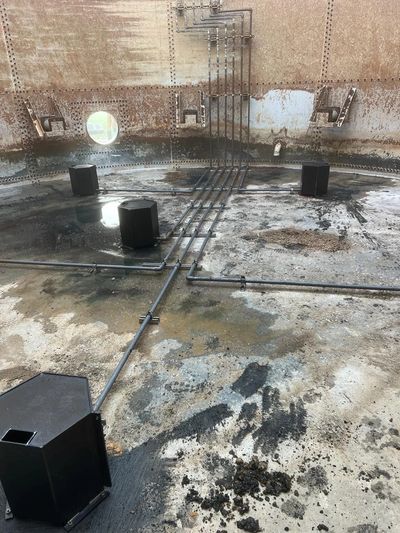
Solids Suspension - Wastewater and Process Systems
Hydra-Bubble™ is a low-pressure, large-bubble mixing system engineered to maximize hydraulic circulation, maintain solids in suspension, and deliver complete basin turnover-independent of oxygen transfer requirements.
Unlike conventional aeration systems that expend most of their energy producing oxygen transfer, Hydra-Bubble is purpose-built for one objective: moving water efficiently.
At the heart of the system is a submerged air accumulator that periodically releases large-volume air slugs. These macro bubbles create powerful buoyancy-driven circulation that moves massive volumes of water throughout the basin, eliminating dead zones and maintaining uniform process conditions with remarkably low energy input.
Typical systems require only 2.8 – 5.1 SCFM per 1,000 ft³ of basin volume, delivering effective mixing with approximately 0.08 – 0.13 horsepower per 1,000 ft³.
The result? Each 1.5 ft³ macro bubble produces approximately 8.6× greater hydraulic mixing performance than conventional coarse-bubble mixing and 9.3× greater hydraulic mixing performance than fine-bubble diffusers, allowing facilities to achieve the same mixing objectives while using dramatically less energy; up to an 88% reduction in energy consumption for equivalent hydraulic mixing performance.
Hydra-Bubble keeps solids suspended, minimizes sediment accumulation, improves basin uniformity, and reduces operating costs; all without relying on excessive aeration airflow.
Hydra-Bubble Large-Bubble Mixing System
How the system generates full-depth hydraulic circulation.
Hydra-Bubble systems are designed around controlled large-bubble generation rather than continuous fine-bubble release.
For typical wastewater treatment basin depths, a nominal bubble volume of approximately 1.5 ft³ provides the optimal balance between stability and hydraulic displacement. The bubble must be large enough to remain coherent during ascent without fragmenting into smaller bubbles before reaching the surface.
If bubbles become too small, they break apart during the rise cycle, reducing hydraulic displacement efficiency and circulation performance. Bubble size adjustments may be required during the design phase for various basin depths to maintain bubble integrity and maximize the current velocity throughout the water column.
The design objective is to generate the smallest stable bubble capable of reaching the surface intact. This maximizes the number of displacement events per SCFM of airflow while maintaining strong vertical lift and basin-scale circulation.

Mixing Designed for Real-World Demands

Full-Column Basin Coverage
Each air release drives vertical lift and outward radial flow, producing a rolling hydraulic circulation pattern that reaches floor-to-surface. This distributed mixing action helps maintain consistent conditions across the full basin volume, especially in deeper tanks where turnover uniformity matters most.
Energy Delivered Through Buoyancy
Typical Hydra designs operate using approximately 80–90% less airflow than conventional coarse-bubble mixing systems. The resulting circulation is generated through buoyancy-driven water displacement rather than localized turbulence, improving the proportion of input energy contributing to whole-basin turnover.

Practical for Retrofits and New Builds
The system is well-suited for drop-in retrofit upgrades and new construction layouts. Installation planning is supported with basin-specific CAD deliverables and spacing guidance to match geometry, depth, and mixing objectives.
A Different Approach to Wastewater Mixing
Not mechanical. Not high-pressure. Is Physics-driven.
Most basin mixing approaches rely on either torque-driven mechanical agitation or high-pressure injection hardware. Hydra-Bubble uses buoyancy-driven displacement to create bulk hydraulic circulation throughout the basin.
The result is full-column turnover delivered through repeatable air-release cycles, with mixing intensity tuned by airflow and layout rather than rotating submerged equipment or elevated pressure injection components.

Lower Energy Demand. Reduced Complexity.

Low-Pressure Air Supply
Hydra-Bubble™ operates using low-pressure blower air, eliminating the need for compressor-driven, high-pressure air injection systems with complex valve assemblies and associated support equipment. By utilizing low-pressure, constant airflow, Hydra-Bubble minimizes pressure losses, reduces system complexity, lowers maintenance requirements, and delivers highly efficient hydraulic mixing with a simpler, more reliable air supply system.
Efficient Bulk Circulation
Mixing energy is delivered through basin-scale circulation patterns instead of localized turbulence. This improves how much of the input energy contributes to whole-tank turnover and solids suspension.
Simplified Submerged Infrastructure
The system avoids rotating submerged assemblies and concentrates complexity above grade where access is easier. Fewer submerged failure points support predictable uptime and simpler maintenance planning.
Scales by Layout, Not Torque
Performance scales by unit count, spacing, and airflow adjustments, allowing designs to match basin geometry without escalating in-tank mechanical horsepower or adding complex submerged drivetrains.
Typical Installations
Anoxic Basins
Lagoons and Large Basins
Equalization Tanks

Full-column circulation for solids suspension and uniform basin conditions in anoxic process zones.
Equalization Tanks
Lagoons and Large Basins
Equalization Tanks
Homogenization and turnover to reduce settling risk and stabilize downstream process performance.
Lagoons and Large Basins
Lagoons and Large Basins
Lagoons and Large Basins
Distributed circulation patterns suited for larger footprints and deeper geometries.
Sludge Holding Tanks
Industrial Process Tanks
Lagoons and Large Basins
Bulk circulation support to reduce stratification and maintain consistent tank conditions.
Industrial Process Tanks
Industrial Process Tanks
Industrial Process Tanks
Turnover and mixing performance tuned to process demands across industrial wastewater applications.
Retrofit Upgrades
Industrial Process Tanks
Industrial Process Tanks
Designed to integrate into existing basins with practical installation layouts and engineering support.