Wastewater Mixing for Municipal and Industrial Treatment
What Is Wastewater Mixing?
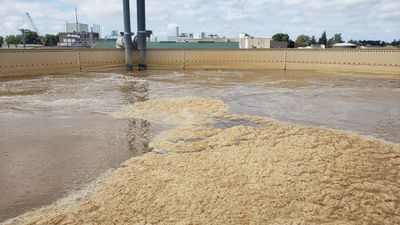
Wastewater mixing is the controlled movement of liquid within treatment basins to maintain solids suspension, prevent stratification, and support stable biological and chemical processes.
In municipal and industrial facilities, proper wastewater mixing ensures uniform distribution of solids, nutrients, and treatment chemicals throughout the basin. Without adequate circulation, solids can settle, biological zones can destabilize, and treatment efficiency can decline.
Effective wastewater mixing systems generate full-depth hydraulic circulation, reaching both the basin floor and surface to eliminate dead zones and maintain consistent process conditions across the entire tank volume.
Types of Wastewater Mixing Systems
Mechanical Mixing Systems - Mechanical wastewater mixing systems use submerged motors and impellers to create torque-driven agitation. These systems generate localized turbulence that induces basin circulation through rotational force.
While effective in certain applications, mechanical mixers introduce submerged moving components that require inspection, seal maintenance, and eventual replacement. Their influence is typically strongest near the impeller, with high energy dissipating as distance from the mixing element increases.
Coarse Bubble Mixing Systems - Coarse bubble mixing systems rely on buoyancy-driven displacement created by rising air bubbles. As air is released into the basin, bubbles rise and displace surrounding water, generating vertical lift and radial flow patterns.
Smaller and coarse bubbles have a relatively high surface-area-to-volume ratio and rise more slowly through the water column. Their slower ascent increases contact time with the surrounding liquid, allowing for moderate oxygen transfer while providing mixing energy.
However, because buoyant force is proportional to displaced water volume, smaller bubbles produce less lifting force per bubble than larger bubbles. As a result, their hydraulic influence is more distributed but less powerful in terms of bulk basin turnover thus requiring more SCFM / Horsepower.
High-Pressure Injection Mixing - High-pressure injection mixing systems use compressed air discharge to create circulation through elevated pressure injection, typically in the range of 100–200 psi. These systems generate medium-sized dispersed bubbles that rise faster than fine bubbles and can still provide some oxygen transfer.
While capable of creating localized flow patterns, high-pressure systems require compressors, control valves, pressure-rated piping, and additional infrastructure to regulate air delivery. The elevated pressure increases system complexity and long-term energy demand.
Because the mixing force is achieved through injection pressure rather than large displacement volume, energy efficiency depends heavily on compression power and system control.
Low Pressure Large-Bubble Mixing - Low-pressure large-bubble mixing uses physics based, high-volume air releases to generate powerful buoyant displacement with no moving parts. Larger bubbles contain significantly greater air volume, and because buoyant force increases with displaced water volume, each large bubble produces substantially more lifting force than smaller bubbles.
As a large bubble rises, it behaves like a piston, driving strong vertical lift and outward hydraulic circulation throughout the basin. These bubbles rise quickly and are not intended for oxygen transfer. Instead, their purpose is efficient bulk energy transfer into the water column.
Because the system operates at low pressure with constant airflow, it does not require high-pressure compressors or complex valve modulation. The result is strong full-depth circulation with reduced energy input and simplified infrastructure.
Large-bubble wastewater mixing systems are commonly applied in anoxic basins, equalization tanks, lagoons, and sludge holding facilities where full-column turnover and solids suspension are required without introducing oxygen.
The effectiveness of bubble mixing is governed by buoyancy force (F = ρVg), meaning that mixing intensity scales directly with displaced water volume nonlinearly.
Anoxic Mixing in Wastewater Treatment
Anoxic mixing refers to circulation within basins where dissolved oxygen must remain low to support biological nutrient removal processes.
In these environments, wastewater mixing systems must maintain solids suspension and uniform nitrate distribution without introducing excessive oxygen. Proper anoxic mixing ensures biological stability while preventing solids deposition and basin stratification.
Large bubble mixing lends itself to anoxic mixing due to its high velocity and relatively low surface area bubbles.
Hydraulic Circulation and Solids Suspension
The primary objective of wastewater mixing is to achieve full-depth hydraulic turnover throughout the basin. Energy introduced into the system must reach the basin floor, walls, and corners to prevent solids accumulation and eliminate stagnant zones.
When mixing energy is properly distributed, solids remain suspended, nutrient concentrations stay uniform, and biological processes operate under stable hydraulic conditions.
Distributed circulation patterns are generally more effective than localized agitation. Systems that create basin-scale vertical and radial flow promote consistent mixing across varying depths and geometries rather than concentrating turbulence in a single mechanical zone.
Large-bubble mixing, compared to torque-driven mechanical agitation, generates strong vertical displacement patterns that extend from floor to surface. While mechanical mixers produce localized eddy currents, large-bubble hydraulic circulation reduces dead zones by promoting full-column turnover. This broader circulation pattern helps mitigate sediment accumulation in corners and along basin perimeters.
Energy Efficiency in Wastewater Mixing
Energy consumption is a significant operational consideration in municipal and industrial wastewater treatment facilities. Mixing systems that rely on high-horsepower motors or elevated air pressure can increase long-term operating costs and introduce additional mechanical complexity.
Low-pressure large-bubble mixing systems transfer energy through buoyancy-driven displacement rather than torque-driven mechanical agitation. As large air slugs rise, they displace substantial volumes of water, creating vertical lift and outward radial flow without relying on submerged rotating equipment.
Mechanical mixers tend to have a localized influence because energy dissipates quickly near the impeller. In contrast, large bubbles continue to influence the entire water column as they rise. As hydrostatic pressure decreases with ascent, the bubble expands, increasing its volumetric influence and enhancing circulation toward the surface.
This buoyancy-driven energy transfer allows mixing intensity to scale with basin depth while maintaining relatively low air pressure requirements.
Selecting a Wastewater Mixing System
Selecting the appropriate wastewater mixing system depends on multiple hydraulic and operational variables:
• Basin depth and geometry
• Process zone (aerobic, anoxic, equalization, sludge holding, channel, MBBR, flocculation)
• Solids concentration and suspension requirements
• Available energy infrastructure
• Maintenance tolerance and staffing
• Integration with existing plant systems
Understanding these variables allows engineers and operators to align mixing technology with treatment objectives and lifecycle cost expectations.
In anoxic zones, mixing must preserve low dissolved oxygen levels while maintaining solids suspension. In equalization basins, homogenization and turnover are critical for stabilizing downstream process loads. In sludge holding tanks, circulation must prevent stratification and reduce accumulation without introducing excessive mechanical complexity.
Proper system selection balances hydraulic performance, energy efficiency, infrastructure compatibility, and long-term reliability.
Engineered Wastewater Mixing Solutions
ENG Designs develops engineered large-bubble wastewater mixing systems designed for predictable hydraulic circulation and operational simplicity.
The Hydra-Bubble™ large-bubble wastewater mixing system delivers low-pressure, full-depth circulation for municipal and industrial basins.
The Hydra-Fusion™ integrated mixing and aeration system combines large-bubble hydraulic circulation with fine-bubble aeration to enhance oxygen transfer while maintaining basin turnover.
The Hydra-Dose™ chemical mixing and distribution system uses controlled air-release cycles to disperse treatment chemicals rapidly and uniformly throughout the basin.
Request Technical Documentation or speak with our engineering team to evaluate wastewater mixing solutions for your facility.