Process Mixing Solutions
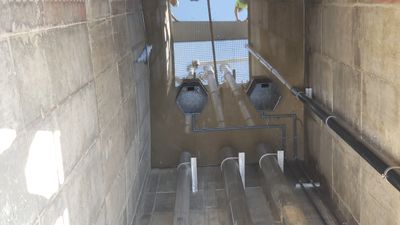
Process-Driven Mixing
Mixing requirements are driven by process consistency, material behavior, and operational reliability-not just circulation.
ENG Designs provides engineered mixing solutions for industrial and municipal applications where maintaining uniform conditions, preventing settling, and achieving reliable distribution are critical to process performance.
Whether the system involves liquids, slurries, or chemical addition, the mixing approach must match the process-not just the tank.
What Industrial Mixing Needs to Solve
Mixing challenges typically show up as performance problems:
- Inconsistent concentration or blending
- Solids settling or accumulation
- Stratification within tanks
- Poor chemical distribution
- Process instability or variability
- Maintenance issues from mechanical equipment
These are not equipment problems first-they are mixing and circulation problems that require the correct approach.
Typical Applications
Wastewater Systems
Mixing for equalization, solids suspension, and process stability in industrial treatment systems.
Chemical Process Tanks
Maintaining uniform conditions for blending, reaction support, and material consistency.
Storage Tanks
Preventing stratification and maintaining uniform composition over time.
Slurry and Solids Systems
Keeping solids suspended and evenly distributed to prevent buildup and process disruption.
Batch and Continuous Processes
Supporting repeatable and stable process conditions across operating cycles.
In these environments, wastewater mixing systems must maintain solids suspension and uniform nitrate distribution without introducing excessive oxygen. Proper anoxic mixing ensures biological stability while preventing solids deposition and basin stratification.
Large bubble mixing lends itself to anoxic mixing due to its high velocity and relatively low surface area bubbles.
Mixing Objectives
Every mixing system starts with defining the objective:
- Suspension: keep solids from settling
- Blending: achieve uniform composition
- Circulation: eliminate dead zones and stagnation
- Dispersion: distribute injected materials quickly and evenly
- Stability: maintain consistent process conditions over time
These objectives determine the system configuration, not the other way around.
Engineering Approach
ENG Designs approaches mixing from an application-first perspective:
- Evaluate tank geometry and volume
- Define mixing objective and performance expectations
- Consider material properties (solids, density, viscosity if applicable)
- Identify process constraints and operational conditions
- Determine appropriate mixing method and system layout
This ensures the system is aligned with actual process requirements rather than generic equipment selection.
Where Bubble Mixing Fits
In certain applications, bubble-based mixing approaches can provide an alternative to conventional mechanical mixing systems.
This approach may be applicable where:
- maintenance reduction is a priority
- mechanical equipment in the tank is undesirable
- circulation and distribution are primary objectives
- solids suspension is required
The suitability depends on the application, and not all systems are appropriate for this approach.
Comparison Framing
Mechanical Mixing Systems
- Common approach across many industries
- Direct energy input via rotating equipment
- Requires maintenance of mechanical components
Air-Driven / Bubble Mixing Approaches
- Focus on circulation and distribution through fluid movement
- Reduced in-tank mechanical complexity
- Application-dependent suitability
When This Applies / When It Doesn’t
This is often a fit when:
- the goal is circulation, suspension, or distribution
- maintenance access is limited
- tank geometry supports circulation-based mixing
- solids management is a concern
This may not be appropriate when:
- high-shear mixing is required
- very specific reaction kinetics dominate mixing requirements
- the process requires mechanical agitation characteristics
Start With Your Process
Mixing systems should be defined based on actual operating conditions—not assumptions.
Provide:
- tank dimensions and geometry
- process objective
- material characteristics (if applicable)
- known issues (settling, stratification, poor distribution, etc.)
ENG Designs can help evaluate the application and determine the appropriate mixing approach.